
The World To Come
Every movie is about the same thing now. For good reason.

This piece has spoilers for The Odyssey, One Battle After Another, Sentimental Value, Marty Supreme, Oppenheimer and Asteroid City. You’ve been warned.
Zohran Mamdani has been mayor of New York City for just over 200 days now. And in that time, he’s received state funding for universal childcare, established the Offices for LGBTQIA+ Affairs and Tenant Protection and closed the city’s $5.4 billion budget. He’s also overseen a successful/fun (partially held in) New York World Cup, despite the government’s intent on turning it into a paranoid clusterfuck, as well as a New York Knicks Championship run, which felt like the first consistently positive and exciting thing in the city in … god knows how long.
The reasons I’m stating this are twofold: 1. It’s nice to think of good things every so often. 2. It feels like a little glimmer of light in an otherwise very dark and treacherous time.
This is far from the first bad time in the U.S. (and the world at large). Still, it’s certainly exacerbated by the day-to-day doldrums of governmental and societal decay, from wildfires turning the air unbreathable to grocery prices that will never drop back down to nonstop/pointless wars halfway across the world. I don’t mean to be a bummer, but it’s tough to be optimistic when a few horde all of the money and a geriatric generation stands still at the top, pushing down any newcomers.
The movies we make, especially from our finest filmmakers, are always a little behind the times—they take years to construct after all—but I’ve been especially interested in how the last six-or-so years of post-COVID movies seem to echo one another. There’s a simple plea for morality and an exhaustion and fear of what the current critically revered filmmakers see as a potential lost world for their children.
The latest epic to take this stance is, of course, The Odyssey.
Christopher Nolan’s blockbuster takes nearly three hours to get to its point, and the point with a twist (that isn’t even really a twist when you think about it) is about how we’re our own worst enemy, creating a lesser world than the one we had when we entered it. “The people from the sea” are just us, and we’re burning everything down just because we can. Even worse, the future generations will have to pay for what we wrought. I thought this passage from Adam Nayman was especially interesting.
It’s about as angsty and anxious as a movie made at its industrial level can be, and its concerns, however obliquely expressed, lie in the present tense. Nolan has taken his studio’s money and put it where his mind is: a good strategy for being taken seriously.
He’s gesturing toward certain geopolitical realities without directly naming them. Take your pick whether that’s subtlety or reticence. The Odyssey isn’t moving, exactly, but it is powerful as a by-product of a filmmaker choosing to stick to his guns (or his crossbow). It gives us one of the greatest stories ever told reimagined as a cautionary tale, the blockbuster as a dark-hued Trojan horse.
The Odyssey is almost a mirror (and at its core, the same story) to Oppenheimer, Nolan’s magnum opus, which revolves around a pivotal scene in which the director’s own daughter has her face ripped apart by a nuclear explosion.
“If you create the ultimate destructive power, it will also destroy those who are near and dear to you,” Nolan explained. “So I suppose this was my way of expressing that in what, to me, were the strongest possible terms.”
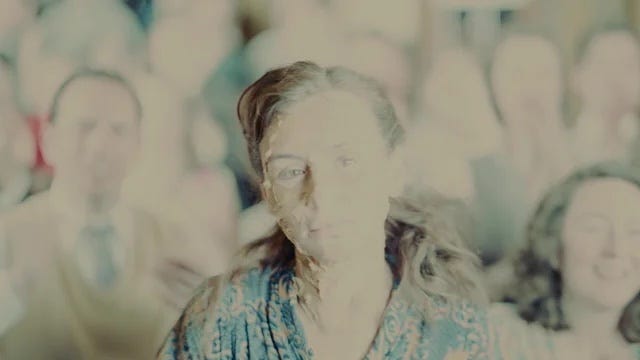
The man is not subtle here. The world has created something that will ruin countless lives to come, and we’ve all been living in the aftermath of J. Robert Oppenheimer’s potential nuclear holocaust ever since.
To be clear, this is far from just a Nolan apprehension. If you look at some of the biggest and most revered movies of the last six years, it’s a constant and a frequently lurking presence.
7-ish Thoughts On The Odyssey

The other night, before watching The Odyssey, I had a dream that I saw The Odyssey. In this dream, I sat in my seat and watched the movie, and then I woke up. This is far from the first time I’ve had a dream like this.
Paul Thomas Anderson’s latest masterpiece, One Battle After Another, is just as evident and perhaps even more transparent: A story about a former revolutionary just trying to keep his daughter safe from morally bankrupt governmental forces.
David Ehrlich wrote about this in IndieWire, questioning why 2025’s best movies were centered on parents looking for answers:
Functioning as a parent requires you to reconcile freedom and fear on a daily basis just in order to step out of your front door every morning; to fudge the data enough to balance the hope of having kids against the horror of having them here. Now. When the oceans are rising, genocide has been normalized, and generations of struggle have left even one-time revolutionaries like “One Battle After Another” protagonist Bob Ferguson to question the basic possibility of lasting progress.
Reconciling freedom and fear on a daily basis isn’t something that Bob really knows how to anymore, and so the former demolition expert known as Ghetto Pat — now a single dad living with his 16-year-old daughter under a pair of aliases in the woodsy NorCal town of Baktan Cross — tends to stay inside, where the self-proclaimed “drugs and alcohol lover” spends all day getting baked out of his mind and wistfully re-watching “The Battle of Algiers” on TV.
It’s rich that Bob Ferguson has turned to movies in a time of turmoil, as we’re doing the exact same thing. Sometimes, you’re living vicariously through the characters; sometimes, you merely are the characters.
I’m sure I’m missing some, but here’s a rundown of some movies that have similar themes, centered on parents trying to understand the daily dread of the world while also endeavoring to raise the next generation. This isn’t a wholly new plot … but at a certain point, there’s a common denominator, and that is the world we live in.
Anyway, here’s the list: Weapons, Marty Supreme, Sorry, Baby, Petite Maman, Asteroid City, Sentimental Value, If I Had Legs I’d Kick You, Project Hail Mary, The Secret Agent, Sinners, A Real Pain, La Chimera, C’mon C’mon, Minari and Are You There God? It’s Me, Margaret. These obviously all dissect this concept to different extents, but they’re all at least partially telling the same story.
The latest is The Odyssey, which is as unmistakable in its worldview as any of these other movies. It’s a decades-spanning and globetrotting epic that at its core is asking one question. And that is…
It appears that Nolan’s greatest anxieties circle around missing out on time with his children, from Interstellar’s bookshelf to Inception’s struggle to return to the real world, as well as worrying over what will happen when he’s gone and the kids have taken over. Will they be content with what they’ve been left with? Most likely not.
This all reminds me (as most things do) of a John Mulaney bit on the elderly voting. I’ll let him tell it, since he’s John Mulaney and I’m not.

“I don’t think [my nana] should vote. You don’t vote when you’re 94 years old. You don’t get to order for the table when you’re about to leave the restaurant.”
It’s fitting that many of these movies end on an open-ended note. Perhaps the most heartwarming is One Battle After Another, in which Chase Infiniti’s Willa goes out to assist others as Tom Petty & The Heartbreakers’ “American Girl” blasts over the end credits. That’s nice, until you remember that she’s just one of a relatively small group, standing up to a murderous government, joining in on yet another protest. There’s hope in that finale, but also fear from Leonardo DiCaprio’s father character.
Marty Supreme is open-ended, showing a father reckoning with himself, unsure how he’ll fare in this new world he’s accidentally constructed. Sentimental Value shows a father and daughter with a boatload of baggage seeing one another for what might be the first time. Asteroid City essentially states to just keep on going after loss and confusion, with the Russian nesting doll analysis of “Just keep telling the story.”
Oppenheimer, on the other hand, is very clear-cut. We’re doomed, and we’ve destroyed it all. (Fun stuff 🙂.) Here’s how the script ends. And yes, it’s in first-person, which is kind of insane but also really works?
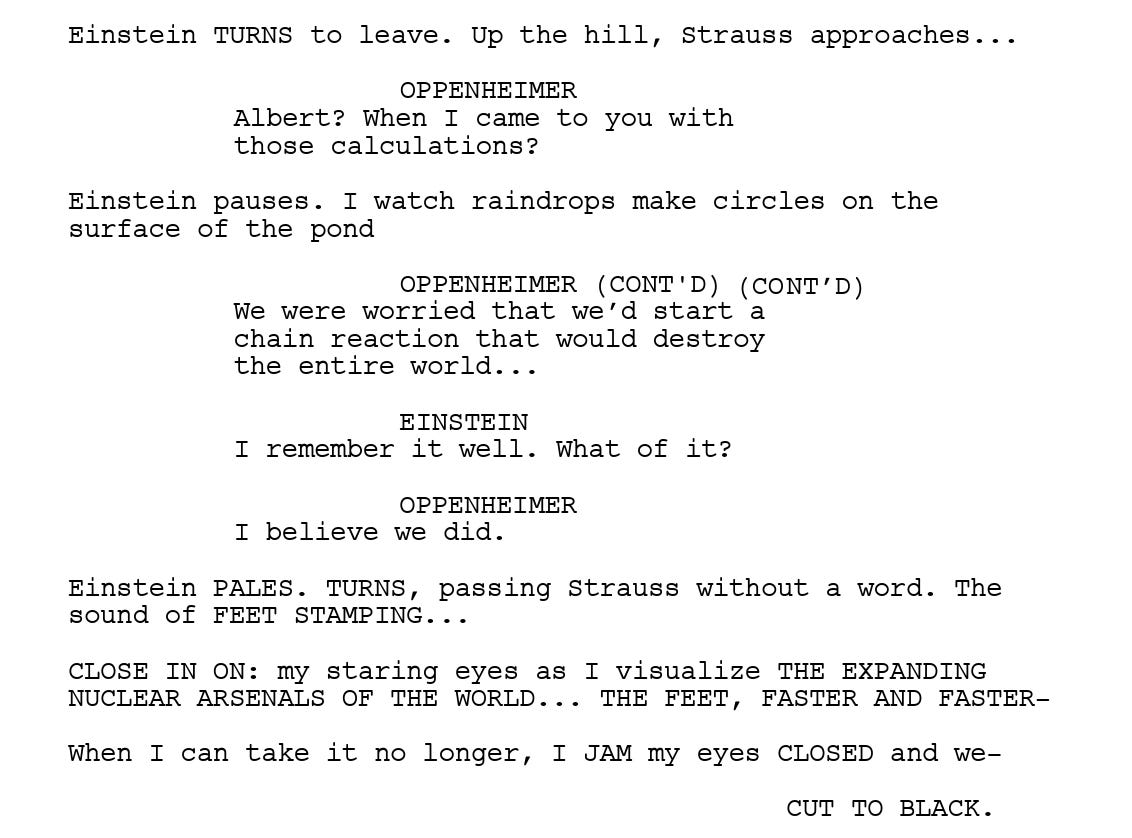
The Odyssey tells the same tale, but simply subs in the Trojan Horse for nuclear weaponry. Both Odysseus and Oppenheimer accomplished something remarkable and historic, but at what cost?
Can we reckon with the world we’ve created? A place where our children have to grow up and try to fix all that we’ve left them? It’s a great set of questions. Unfortunately, we can’t depend on Christopher Nolan, Paul Thomas Anderson, Mary Bronstein, Wes Anderson or Alice Rohrwacher for answers.
We have to figure it out ourselves, à la Telemachus. Which sucks and is also just the way the cards were rolled out for us.